LeetsGoAgain
补充题目
1365.有多少小于当前数字的数字
https://leetcode.cn/problems/how-many-numbers-are-smaller-than-the-current-number/
给你一个数组 nums,对于其中每个元素 nums[i],请你统计数组中比它小的所有数字的数目。
换而言之,对于每个 nums[i] 你必须计算出有效的 j 的数量,其中 j 满足 j != i 且 nums[j] < nums[i] 。
以数组形式返回答案。
我的思路:
首先暴力肯定是 $O(n^2)$。所以我这里优化一下,用一个 multimap 试一下。key是这个数字,value是它的下标。然后最后遍历一次 multimap, 就可以直接把结果填到 result 数组中。
class Solution {
public:
    vector<int> smallerNumbersThanCurrent(vector<int>& nums) {
        std::multimap<int, int> mmap;
        // build index
        for(int i = 0; i < nums.size(); ++i)
            mmap.insert({nums[i], i});
        // search
        auto result = std::vector<int>(nums.size());
        // 这里要特别处理数字相同的情况
        int fill_in_num = 0;
        int cur_idx = 0;
        int prev = 0;
        for(const auto& e : mmap) {
            if(cur_idx != 0 && e.first == prev) {
                // 遇到数字相同的情况
                result[e.second] = fill_in_num;
                prev = e.first;
                cur_idx++;
            } else {
                fill_in_num = cur_idx;
                result[e.second] = fill_in_num;
                prev = e.first;
                cur_idx++;
            }
        }
        return result;
    }
};
可以通过。
Carl的思路和我的大致是一样的,他是用hashmap,然后也是记住下标在哪。所以是一样的。
941. 有效的山脉数组
https://leetcode.cn/problems/valid-mountain-array/description/
class Solution {
public:
    bool validMountainArray(vector<int>& arr) {
        // 先计算前缀和数组
        std::vector<int> prefix;
        for(int i = 1; i < arr.size(); ++i)
            prefix.push_back(arr[i] - arr[i-1]);
        // check if valid
        bool prefixFlag = false; // 记录是否达到山峰
        for(int i = 0; i < prefix.size(); ++i) {
            if(i == 0 && prefix[i] < 0) return false;
            if(!prefixFlag && prefix[i] > 0) continue;
            else if(prefix[i] == 0) return false;
            else if(!prefixFlag && prefix[i] < 0) prefixFlag = true;
            else if(prefixFlag && prefix[i] < 0) continue;
            else if(prefixFlag && prefix[i] > 0) return false;
        }
        return prefixFlag == true;
    }
};
这题很简单,没啥好说的,按照题目定义去弄就行了。
1207. 独一无二的出现次数
https://leetcode.cn/problems/unique-number-of-occurrences/
给你一个整数数组 arr,如果每个数的出现次数都是独一无二的,就返回 true;否则返回 false。
简单题。
class Solution {
public:
    bool uniqueOccurrences(vector<int>& arr) {
        std::unordered_map<int, int> umap;
        for(const auto& e : arr)
            umap[e]++;
        std::unordered_set<int> uset;
        for(const auto& e : umap){
            if(uset.find(e.second) != uset.end()) return false;
            uset.insert(e.second);
        }
        return true;
    }
};
283. 移动零
https://leetcode.cn/problems/move-zeroes/
给定一个数组 nums,编写一个函数将所有 0 移动到数组的末尾,同时保持非零元素的相对顺序。
请注意 ,必须在不复制数组的情况下原地对数组进行操作。
双指针就行了,这题也可以看成是双指针题目的一个复习了。
class Solution {
public:
    void moveZeroes(vector<int>& nums) {
        // fast指针,如果遇到不是0的,就copy到slow指针上
        int fast = 0; int slow = 0;
        while(fast < nums.size() && slow < nums.size()) {
            while(fast < nums.size() && nums[fast] == 0) fast++;
            // 此时fast指向一个非0的合法数字
            // while(slow < nums.size() && nums[slow] != 0) slow++;
            if(fast >= nums.size()) break;
            // 此时 slow 指向 0
            nums[slow++] = nums[fast++];
        }
        while(slow < nums.size()) nums[slow++] = 0;
    }
};
顺利通过。
189. 轮转数组
https://leetcode.cn/problems/rotate-array/description/
给定一个整数数组 nums,将数组中的元素向右轮转 k 个位置,其中 k 是非负数。
这题我是记得的,把前k个和后n-k个分别逆序,然后整体逆序即可。
class Solution {
private:
    using it = std::vector<int>::iterator;
    void reverse(it begin, it end) {
        while(begin < end) std::swap(*begin++, *end--);
    }
public:
    void rotate(vector<int>& nums, int k) {
        if(k > nums.size()) k %= nums.size(); // 这一步很重要,不然会越界访问
        reverse(nums.begin(), nums.begin() + (nums.size() - k) - 1);
        reverse(nums.begin() + (nums.size() - k), nums.end() - 1);
        reverse(nums.begin(), nums.end() - 1);
    }
};
轻松简单。
724. 寻找数组的中心下标
https://leetcode.cn/problems/find-pivot-index/description/
class Solution {
public:
    int pivotIndex(vector<int>& nums) {
        int sum = std::accumulate(nums.begin(), nums.end(), 0);
        std::cout << sum << std::endl; // -6
        int leftSum = 0;
        for(int i = 0; i < nums.size(); ++i) {
            std::cout << sum - nums[i] << std::endl;
            if(abs(sum - nums[i]) % 2 == 1) { // 因为这里有负数,这里要处理一下
                leftSum += nums[i];
                continue;
            }
            int target = (sum - nums[i]) / 2;
            if(leftSum == target) return i;
            else{
                leftSum += nums[i];
                continue;
            }
        }
        return -1;
    }
};
Carl的思路也是一样的。
34. 在排序数组中查找元素的第一个和最后一个位置
https://leetcode.cn/problems/find-first-and-last-position-of-element-in-sorted-array/description/
给你一个按照非递减顺序排列的整数数组 nums,和一个目标值 target。请你找出给定目标值在数组中的开始位置和结束位置。
如果数组中不存在目标值 target,返回 [-1, -1]。
你必须设计并实现时间复杂度为 O(log n) 的算法解决此问题。
我先试试直接分成两个函数来找,然后再看看怎么合并。
class Solution {
private:
    int find_lower_bound(const std::vector<int>& nums, int target) {
        int left = 0;
        int right = nums.size() - 1;
        if(nums[left] == target) return left;
        while(left < right) {
            int mid = (left + right) / 2;
            if(nums[mid] < target) left = mid;
            else if(nums[mid] >= target) right = mid;
            if(left + 1 == right) {
                left++; break;
            }
        }
        assert(left == right);
        return nums[right] == target ? right : -1;
    }
    int find_upper_bound(const std::vector<int>& nums, int target) {
        int left = 0;
        int right = nums.size() - 1;
        if(nums[right] == target) return right;
        while(left < right) {
            int mid = (left + right) / 2;
            if(nums[mid] <= target) left = mid;
            else if(nums[mid] > target) right = mid;
            if(left + 1 == right) {
                right--; break;
            }
        }
        assert(left == right);
        return nums[left] == target ? left : -1;
    }
public:
    vector<int> searchRange(vector<int>& nums, int target) {
        if(nums.size() == 0) return {-1, -1};
        int left = find_lower_bound(nums, target);
        int right = find_upper_bound(nums, target);
        return {left, right};
    }
};
虽然做出来了,但是感觉写的有点捞。感觉做了很多判断。不过这题也没啥好说的。
922. 按奇偶排序数组 II
https://leetcode.cn/problems/sort-array-by-parity-ii/description/
给定一个非负整数数组 nums, nums 中一半整数是 奇数 ,一半整数是 偶数 。
对数组进行排序,以便当 nums[i] 为奇数时,i 也是 奇数 ;当 nums[i] 为偶数时, i 也是 偶数 。
你可以返回 任何满足上述条件的数组作为答案 。
我感觉可以控制两个指针,一个来指向奇数位置,一个指向偶数位置。
然后遇到不合法的就停下来。进行swap。
class Solution {
public:
    vector<int> sortArrayByParityII(vector<int>& nums) {
        // 控制两个指针
        int odd_ptr = 1;
        int even_ptr = 0;
        while(odd_ptr < nums.size() && even_ptr < nums.size()) {
            // 寻找奇数指针的非法位置
            while(odd_ptr < nums.size() && nums[odd_ptr] % 2 == 1) odd_ptr += 2;
            // 寻找偶数指针的非法位置
            while(even_ptr < nums.size() && nums[even_ptr] % 2 == 0) even_ptr += 2;
            // 因为题目说明了一半一半,所以这里放心
            if(odd_ptr < nums.size() && even_ptr < nums.size())
                std::swap(nums[odd_ptr], nums[even_ptr]);
            else break;
        }
        return nums;
    }
};
顺利通过,简单。
35. 搜索插入位置
https://leetcode.cn/problems/search-insert-position/description/
给定一个排序数组和一个目标值,在数组中找到目标值,并返回其索引。如果目标值不存在于数组中,返回它将会被按顺序插入的位置。
请必须使用时间复杂度为 O(log n) 的算法。
搜索树的插入,不多说。
class Solution {
public:
    int searchInsert(vector<int>& nums, int target) {
        int left = 0;
        int right = nums.size() - 1;
        while(left <= right) {
            if(nums[left] == target) return left;
            if(nums[right] == target) return right;
            int mid = (left + right) / 2;
            if(nums[mid] < target) left = mid + 1;
            else if(nums[mid] > target) right = mid - 1;
            else if(nums[mid] == target) return mid;
        }
        return left;
    }
};
24. 两两交换链表中的节点
https://leetcode.cn/problems/swap-nodes-in-pairs/description/
这个没问题,我擅长的领域来了。
/**
 * Definition for singly-linked list.
 * struct ListNode {
 *     int val;
 *     ListNode *next;
 *     ListNode() : val(0), next(nullptr) {}
 *     ListNode(int x) : val(x), next(nullptr) {}
 *     ListNode(int x, ListNode *next) : val(x), next(next) {}
 * };
 */
class Solution {
public:
    ListNode* swapPairs(ListNode* head) {
        if(!head) return nullptr;
        if(head->next == nullptr) return head; // 只有一个节点
        // 弄个dummy节点
        ListNode* dummy_head = new ListNode(0);
        dummy_head->next = head;
        ListNode* prev = dummy_head;
        ListNode* ptr1 = head;
        ListNode* ptr2 = head->next;
        while(ptr2) {
            ListNode* nnext = ptr2->next;
            // 交换ptr1, ptr2
            prev->next = ptr2;
            ptr2->next = ptr1;
            ptr1->next = nnext;
            // 迭代
            prev = ptr1;
            ptr1 = nnext;
            if(!ptr1) break;
            ptr2 = ptr1->next;
        }
        return dummy_head->next;
    }
};
234. 回文链表
https://leetcode.cn/problems/palindrome-linked-list/description/
class Solution {
public:
    bool isPalindrome(ListNode* head) {
        // 题目说了不能为空
        if(head->next == nullptr) return true;
        // 先计算链表长度
        int len = 0;
        ListNode* cur = head;
        while(cur) {
            cur = cur->next;
            len++;
        }
        // len可能是奇数也可能是偶数
        ListNode* dummy_head = new ListNode();
        // 头插
        cur = head;
        ListNode* new_list_next = dummy_head->next;
        for(int i = 0; i < len / 2; ++i) {
            auto next = cur->next;
            dummy_head->next = cur;
            cur->next = new_list_next;
            new_list_next = cur;
            cur = next;
        }
        // 匹配
        ListNode* match_head1 = nullptr;
        if(len % 2 == 0)
            match_head1 = cur;
        else if(len % 2 == 1)
            match_head1 = cur->next;
        ListNode* match_head2 = dummy_head->next;
        while(match_head1 && match_head2) {
            if(match_head1->val != match_head2->val) return false;
            match_head1 = match_head1->next;
            match_head2 = match_head2->next;
        }
        if(match_head1 && !match_head2) return false;
        if(!match_head1 && match_head2) return false;
        return true;
    }
};
虽然有些复杂,但一次过。链表果然是我的主场。
- 计算长度
- 把前一半头插到另一个哨兵头中,完成前半部分翻转
- 长度是奇数和偶数是有区别的,如果是奇数,match的时候要略过最中间那个
- 最后一个一个match就行了
- 计算长度遍历一次,然后match的时候遍历第二次,O(n)
143. 重排链表
https://leetcode.cn/problems/reorder-list/description/
给定一个单链表 L 的头节点 head ,单链表 L 表示为:
L0 → L1 → … → Ln - 1 → Ln 请将其重新排列后变为:
L0 → Ln → L1 → Ln - 1 → L2 → Ln - 2 → …
不能只是单纯的改变节点内部的值,而是需要实际的进行节点交换。
我的思路,先拿出来然后插进去,这样遍历两次,也是 O(n)
class Solution {
public:
    void reorderList(ListNode* head) {
        if(head->next == nullptr) return; // 1个节点的情况
        // 计算链表长度
        int len = 0;
        ListNode* cur = head;
        while(cur) {
            cur = cur->next;
            len++;
        }
        int subLen = (len % 2 == 1) ? len/2+1 : len/2;
        // 跳过前sublen个
        cur = head;
        ListNode* prev = nullptr;
        while(subLen--) {
            prev = cur;
            cur = cur->next;
        }
        prev->next = nullptr; // 断开链表
        //
        ListNode* dummy_head = new ListNode();
        ListNode* nnext = dummy_head->next; // null
        while(cur) {
            ListNode* next = cur->next;
            dummy_head->next = cur;
            cur->next = nnext;
            nnext = cur;
            cur = next;
        }
        // debug new linkedlist:
        // ListNode* debug_cur = dummy_head;
        // while(debug_cur) {
        //     std::cout << debug_cur->val << " ";
        //     debug_cur = debug_cur->next;
        // }
        // debug_cur = head;
        // std::cout << std::endl;
        // while(debug_cur) {
        //     std::cout << debug_cur->val << " ";
        //     debug_cur = debug_cur->next;
        // }
        // exit(1);
        ListNode* insert_prev = head;
        ListNode* insert_cur = head->next;
        ListNode* new_list_cur = dummy_head->next;
        // exit(1);
        while(new_list_cur) {
            ListNode* new_list_next = new_list_cur->next;
            insert_prev->next = new_list_cur;
            new_list_cur->next = insert_cur;
            new_list_cur = new_list_next;
            // 迭代
            if(!insert_cur) {
                std::cout << "hello" << std::endl;
                break;
            }
            insert_prev = insert_cur;
            insert_cur = insert_prev->next;
        }
        // debug
        // ListNode* debug_cur = head;
        // while(debug_cur) {
        //     std::cout << debug_cur->val << " ";
        //     debug_cur = debug_cur->next;
        // }
        // std::cout << "here" << std::endl;
    }
};
debug了一会儿,最终还是没问题,做出来了。
141. 环形链表
https://leetcode.cn/problems/linked-list-cycle/description/
经典题目,快慢指针。
class Solution {
public:
    bool hasCycle(ListNode *head) {
        ListNode* fast = head;
        ListNode* slow = head;
        while(fast && fast->next) {
            fast = fast->next->next;
            slow = slow->next;
            if(fast == slow) return true;
        }
        return false;
    }
};
205. 同构字符串
https://leetcode.cn/problems/isomorphic-strings/description/
给定两个字符串 s 和 t ,判断它们是否是同构的。
如果 s 中的字符可以按某种映射关系替换得到 t ,那么这两个字符串是同构的。
每个出现的字符都应当映射到另一个字符,同时不改变字符的顺序。不同字符不能映射到同一个字符上,相同字符只能映射到同一个字符上,字符可以映射到自己本身。
输入:s = “egg”, t = “add”
输出:true
感觉可以用哈希表进行一个编码,只要新出现一个字符,就赋予一个数字。
class Solution {
private:
    std::vector<int> encoder(const std::string& s) {
        // 做一个编码,看编码是否相同就行了
        std::unordered_map<char, int> umap;
        std::vector<int> encode_result;
        int noteNumber = 0;
        for(const auto& e : s) {
            if(umap.find(e) == umap.end()) {
                // 这个字符第一次出现
                umap[e] = noteNumber++;
                encode_result.push_back(noteNumber);
            }
            else {
                encode_result.push_back(umap[e]);
            }
        }
        return encode_result;
    }
public:
    bool isIsomorphic(string s, string t) {
        return encoder(s) == encoder(t);
    }
};
1002. 查找共用字符
https://leetcode.cn/problems/find-common-characters/description/
给你一个字符串数组 words ,请你找出所有在 words 的每个字符串中都出现的共用字符(包括重复字符),并以数组形式返回。你可以按 任意顺序 返回答案。
示例 1:
输入:words = [“bella”,”label”,”roller”]
输出:[“e”,”l”,”l”] \
示例 2:
输入:words = [“cool”,”lock”,”cook”]
输出:[“c”,”o”]
这题的思路有点抽象,一下子没有想到特别好的方法。看了Carl的思路才想到。
Carl的思路:
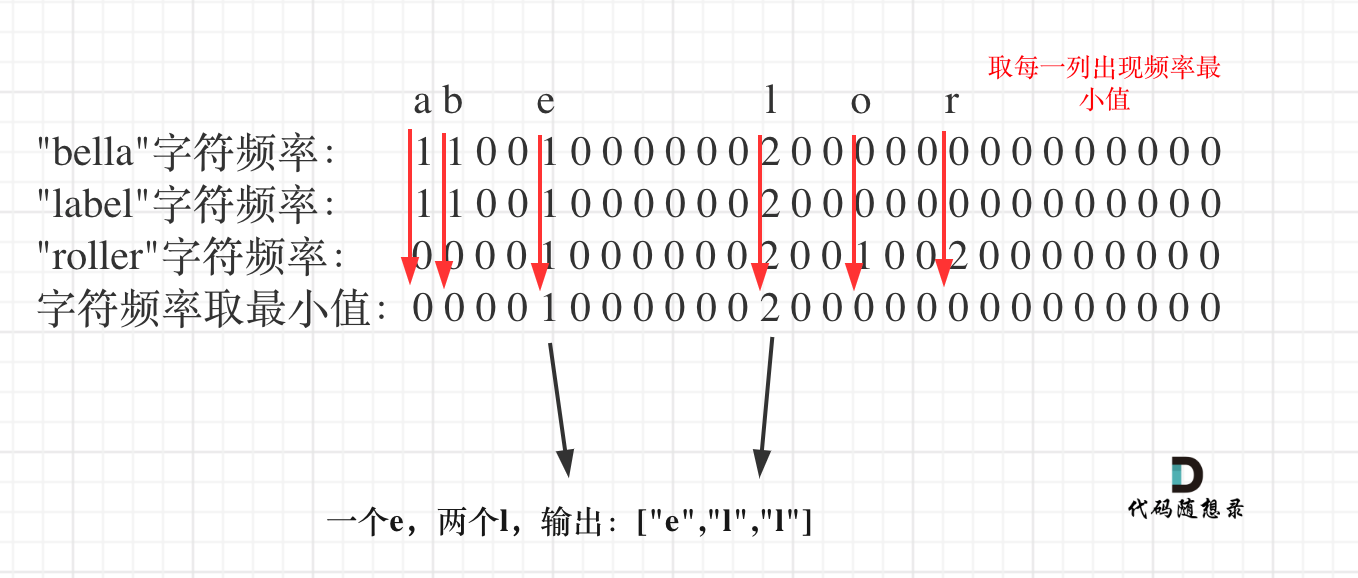
按照这个思路,可以顺利通过。
class Solution {
private:
    std::vector<int> encoder(const std::string& str) {
        auto hash = std::vector<int>(26);
        for(const auto& e : str)
            hash[e - 'a'] += 1;
        return hash;
    }
public:
    vector<string> commonChars(vector<string>& words) {
        std::vector<std::vector<int>>hash_res;
        for(const auto& e: words)
            hash_res.push_back(encoder(e));
        // 处理最后结果
        std::vector<std::string> res;
        for(int j = 0; j < 26; ++j) {
            int _min = INT_MAX;
            for(int i = 0; i < hash_res.size(); ++i)
                _min = std::min(hash_res[i][j], _min);
            if(_min > 0)
                for(int k = 0; k < _min; ++k)
                    res.push_back(std::string(1, j+'a'));
        }
        return res;
    }
};
925. 长按键入
https://leetcode.cn/problems/long-pressed-name/description/
我原本是按照这个方法的:
class Solution {
public:
    bool isLongPressedName(string name, string typed) {
        // 先用哈希表记录第二个字符串
        std::unordered_map<char, int> umap;
        for(const auto& e : typed)
            umap[e]++;
        // 遍历第一个字符串
        for(const auto& e : name) {
            if(umap.find(e) != umap.end() && umap[e] > 0)
                umap[e]--;
            else return false;
        }
        return true;
    }
};
但是这样确实有bug。
name = “rick”
typed = “kric”
应该是 false 而不是 true
所以哈希是不行的,要有顺序。
所以按照Carl的思路,改用双指针吧
class Solution {
public:
    bool isLongPressedName(string name, string typed) {
        int name_ptr = 0;
        int typed_ptr = 0;
        while(name_ptr < name.size() && typed_ptr < typed.size()) {
            std::cout << name[name_ptr] << ":" << typed[typed_ptr] << std::endl;
            if(name[name_ptr] != typed[typed_ptr]) return false;
            int type_skip_num = 0;
            while(typed_ptr + 1 < typed.size() && typed[typed_ptr + 1] == typed[typed_ptr]) {
                type_skip_num++;
                typed_ptr++;
            }
            // 此时 name_ptr 也要跳过重复字符
            int name_skip_num = 0;
            while(name_ptr + 1 < name.size() && name[name_ptr + 1] == name[name_ptr]) {
                name_skip_num++;
                name_ptr++;
            }
            if(name_skip_num > type_skip_num) return false;
            typed_ptr++; name_ptr++;
        }
        // 如果typed还有剩下,肯定有问题
        if(typed_ptr < typed.size() || name_ptr < name.size()) return false;
        return true;
    }
};
我是双指针,但和Carl的思路也不是完全一样的,问题不大,debug了一下也通过了。
844. 比较含退格的字符串
https://leetcode.cn/problems/backspace-string-compare/description/
class Solution {
public:
    bool backspaceCompare(string s, string t) {
        std::vector<char> st;
        for(int i = 0; i < s.size(); ++i)
            if(s[i] != '#') st.push_back(s[i]);
            else
                if(!st.empty()) st.pop_back();
        std::string str1(st.begin(), st.end());
        st.clear();
        for(int i = 0; i < t.size(); ++i)
            if(t[i] != '#') st.push_back(t[i]);
            else
                if(!st.empty()) st.pop_back();
        std::string str2(st.begin(), st.end());
        return str1 == str2;
    }
};
很简单,用栈就可以了,但是为了比对更方便,用了vector代替stack,stack毕竟没有迭代器。
129. 求根节点到叶节点数字之和
https://leetcode.cn/problems/sum-root-to-leaf-numbers/description/
class Solution {
private:
    std::vector<std::vector<int>> all_paths;
    std::vector<int> layer;
    void dfs(TreeNode* root) {
        if(!root) assert(false);
        layer.push_back(root->val);
        if(!root->left && !root->right) {
            all_paths.push_back(layer);
            layer.pop_back();
            return;
        }
        if(root->left) dfs(root->left);
        if(root->right) dfs(root->right);
        layer.pop_back();
    }
    int transferVec2Num(std::vector<int>& vec) {
        // reverse the list: O(n)
        std::reverse(vec.begin(), vec.end());
        int sum = 0;
        for(int i = 0; i < vec.size(); ++i)
            sum += (pow(10, i) * vec[i]);
        return sum;
    }
public:
    int sumNumbers(TreeNode* root) {
        // 先用vec存储所有路径上的数字
        if(!root) return 0;
        dfs(root);
        // debug
        // for(int i = 0; i < all_paths.size(); ++i) {
        //     for(int j = 0; j < all_paths[i].size(); ++j) {
        //         std::cout << all_paths[i][j] << " ";
        //     }
        //     std::cout << std::endl;
        // }
        // return -1;
        int res = 0;
        for(int i = 0; i < all_paths.size(); ++i)
            res += transferVec2Num(all_paths[i]);
        return res;
    }
};
顺利通过。
- 先拿到每条路径的所有数字
- 再把每条路径转化成题目要求的结果
1382. 将二叉搜索树变平衡
https://leetcode.cn/problems/balance-a-binary-search-tree/description/
这题Carl的思路,也是重新构造,用有序数组重新构造。
/**
 * Definition for a binary tree node.
 * struct TreeNode {
 *     int val;
 *     TreeNode *left;
 *     TreeNode *right;
 *     TreeNode() : val(0), left(nullptr), right(nullptr) {}
 *     TreeNode(int x) : val(x), left(nullptr), right(nullptr) {}
 *     TreeNode(int x, TreeNode *left, TreeNode *right) : val(x), left(left), right(right) {}
 * };
 */
class Solution {
private:
    std::vector<int> inOrder;
    void dfs(TreeNode* root) {
        if(!root) return;
        dfs(root->left);
        inOrder.push_back(root->val);
        dfs(root->right);
    }
    TreeNode* buildBalanceBST(const std::vector<int>& nums) {
        if(nums.size() == 0) return nullptr;
        if(nums.size() == 1) return new TreeNode(nums[0]);
        // 获取中间节点
        int mid = nums.size() / 2;
        TreeNode* root = new TreeNode(nums[mid]);
        TreeNode* left = buildBalanceBST(std::vector<int>(nums.begin(), nums.begin() + mid));
        TreeNode* right = buildBalanceBST(std::vector<int>(nums.begin() + mid + 1, nums.end()));
        root->left = left;
        root->right = right;
        return root;
    }
public:
    TreeNode* balanceBST(TreeNode* root) {
        dfs(root);
        return buildBalanceBST(inOrder);
    }
};
easy, 顺利通过。
116. 填充每个节点的下一个右侧节点指针
https://leetcode.cn/problems/populating-next-right-pointers-in-each-node/description/
这题不就是层序遍历不就行了吗
class Solution {
private:
    std::vector<std::vector<Node*>> layersResult;
    void bfs(Node* root) {
        if(!root) return;
        std::queue<Node*> q;
        q.push(root);
        while(!q.empty()) {
            int sz = q.size();
            std::vector<Node*> layer;
            for(int i = 0; i < sz; ++i) {
                Node* node = q.front();
                q.pop();
                layer.push_back(node);
                if(node->left) q.push(node->left);
                if(node->right) q.push(node->right);
            }
            layersResult.push_back(layer);
        }
    }
public:
    Node* connect(Node* root) {
        bfs(root);
        for(int i = 0; i < layersResult.size(); ++i) {
            for(int j = 0; j < layersResult[i].size(); ++j) {
                if(j == layersResult[i].size() - 1) layersResult[i][j]->next = nullptr;
                else layersResult[i][j]->next = layersResult[i][j+1];
            }
        }
        return root;
    }
};