Polynomial-Time Reductions and the Foundations of NP-Completeness
Polynomial-Time Reductions and the Foundations of NP-Completeness
Polynomial-Time Reduction
In complexity theory, "reduction" is the most important tool for studying the difficulty of a problem.
First, let's clarify what reduction means.
We often say:
If problem X is at least as hard as problem Y, it means that if we can solve X, we can incidentally solve Y.
This is easy to understand.
Formally, it's defined as polynomial reduction:
\
Y can be solved using a polynomial-time algorithm, plus a black box that calls X several times.
Intuitive Understanding:
We want to solve Y
But we can't
So we transform Y into X
As long as there's a black box that can solve X, we can solve Y.
Reduction helps us compare the difficulty of problems.
Understanding Method:
If everyone can replace Y with X in polynomial time
Then X is at least no simpler than Y
Independent Set vs. Vertex Cover: The Classic Mutual Reduction
To intuitively understand reduction, we'll start with two simple and closely related problems.
Independent Set Problem and Vertex Cover Set Problem
The descriptions of these two problems have been covered in the previous two chapters and will not be repeated here.
Important FACT
Very Important:
In a graph
Intuition:
If no two vertices in S are adjacent
Then every edge has at least one endpoint outside
Therefore, the complement
and vice versa.
This complement relationship naturally leads to reduction.
Mutual Reduction
Question: Does G have an independent set ≥ k?
Transformed into:
Question: Does G have a vertex cover ≤ n − k?
Reason:
S is an independent set
V−S is a vertex cover
|V−S| = n − |S|
Therefore, |S| ≥ k ⇔ |V−S| ≤ n−k
Therefore, we only need to ask the black box:
“Does the vertex cover size ≤ n−k?”
If the black box answers YES, then the Independent Set answer is also YES.
Similarly:
Judging “VC ≤ k” is equivalent to judging “IS ≥ n−k”.
These two reductions are known conclusions and can be used directly. **
Set Cover: A More General Form of Vertex Cover
Definition of Set Cover:
Given a set of elements
Vertex Cover can be reduced to Set Cover:
Elements = Edges of the graph
Each vertex v corresponds to a set S(v) containing all edges connected to v
Choosing a vertex to cover edges ⇔ Choosing sets to cover elements
Therefore:
So Set Cover is at least as difficult as Vertex Cover.
Reduction Using Gadgets (From SAT to Graph)
Next, we move on to "gadget construction" in complexity theory.
A gadget is a small structure used to simulate logical relationships.
This section aims to:
Introduce clause, literal, and assignment
Then, using a gadget, reduce 3-SAT to an Independent Set
This part is the core technique for NP-completeness.
Clause and Literal
Clause = Several literals connected by OR
Literal = Variable x or its negation ¬x
This concept was actually discussed earlier when the SAT problem was mentioned.
When does an assignment satisfy a clause? The clause is satisfied as long as at least one literal is true.
SAT and 3-SAT
SAT Problem:
Does an assignment to a variable make all clauses true?
For example, given several clauses:
We need to find an assignment to a variable that makes all clauses true.
3-SAT is a special case: each clause has exactly 3 literals.
Reduction:
This is one of the most classic reductions in NP-complete theory. **
(1) Create a triangle gadget for each clause
For example, clause:
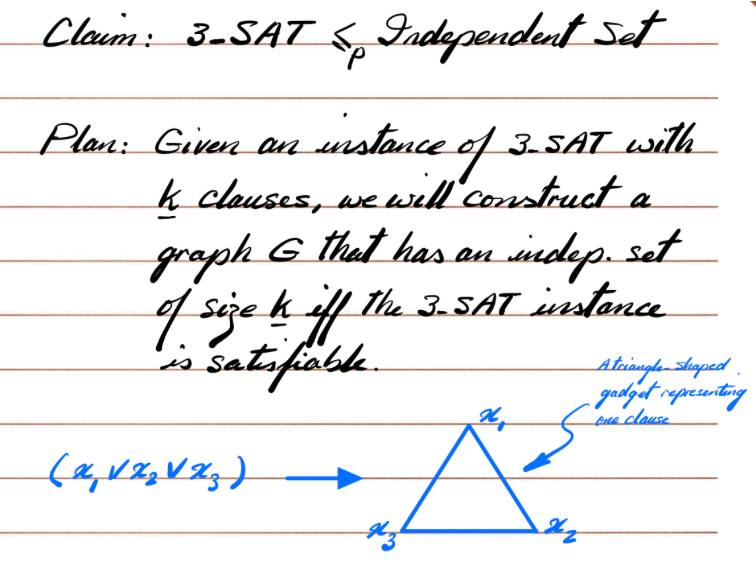
The triangle guarantees:
You cannot select two literals in the same clause at the same time
Each clause can take at most 1 point as a member of IS
This means:
"At least one point in a clause is true"
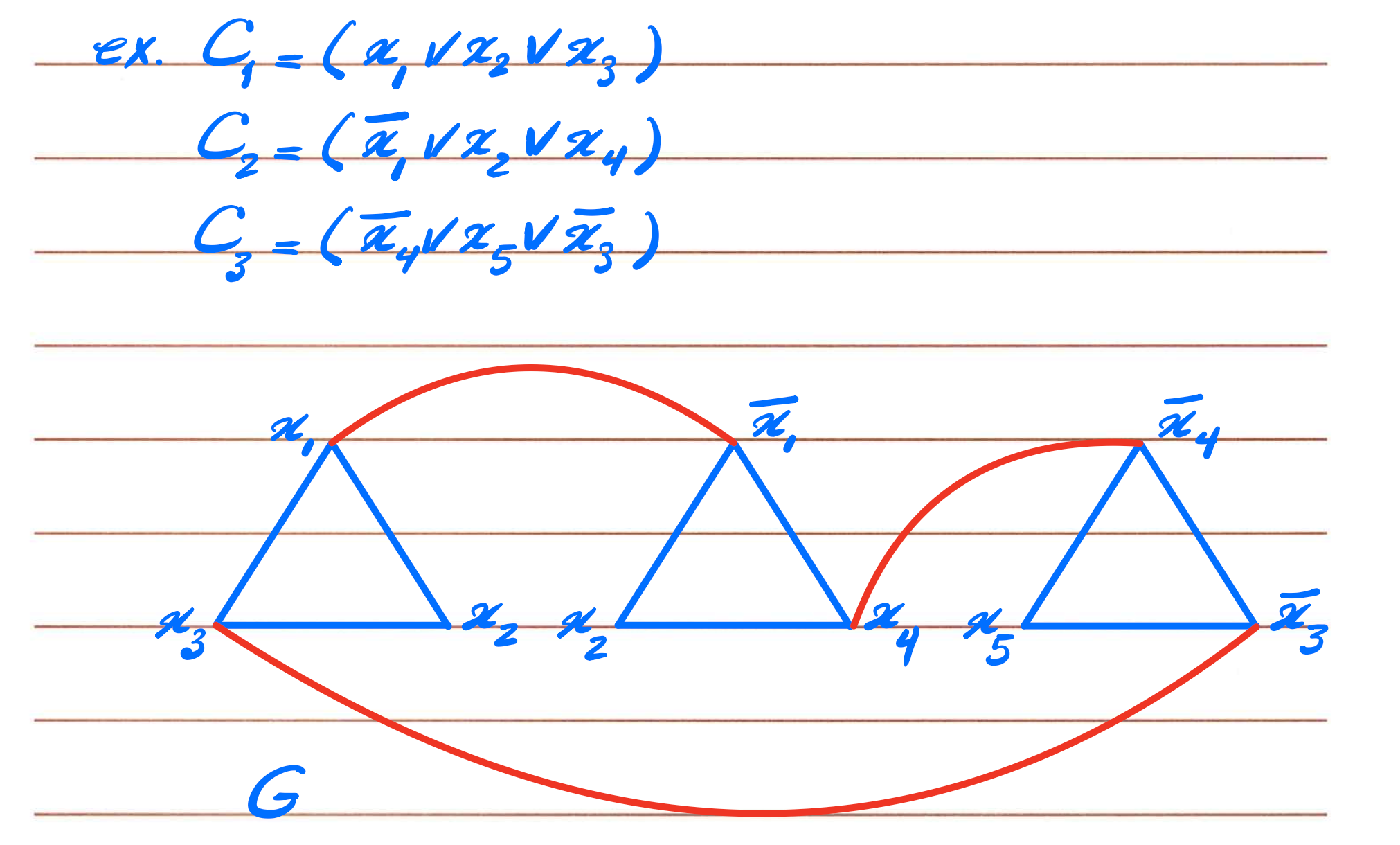
(2) Prohibit x and ¬x from being selected at the same time (add conflict edges)
If literal a means "x = true", literal b means "x = false"
→ You cannot select both into the independent set
→ Connect them with an edge
Prove the correctness of the reduction in two directions
A. If 3-SAT satisfies → There exists an independent set of size = number of clauses
Select one true for each clause Literal:
Choose one from each triangle
No conflict (x and ¬x cannot both be true)
Therefore, an independent set is formed
B. If there exists an independent set of size = number of clauses → a satisfying assignment can be constructed
Because:
Only one can be chosen from each triangle
A total of k triangles were chosen (k = number of clauses)
→ Each clause chooses one literal
→ Assigning the chosen literal to true → a satisfying assignment is obtained
NP-hard and NP-complete
NP-hard definition (at least this difficult)
A problem X is NP-hard if:
All problems Y in NP can be reduced to X (
NP-hard does not require:
X is in NP
X is verifiable
X is decisionable
Example: Halting Problem
NP-complete Definition
(Important Definition) A problem X is NP-complete if and only if:
X ∈ NP (verifiable)
For all Y ∈ NP, Y ≤ ₚ X (hardest)
Properties:
NP-complete is the "hardest core" of NP
If an NP-complete problem can be solved polytime,
then all NP problems can be solved polytime,
and P = NP
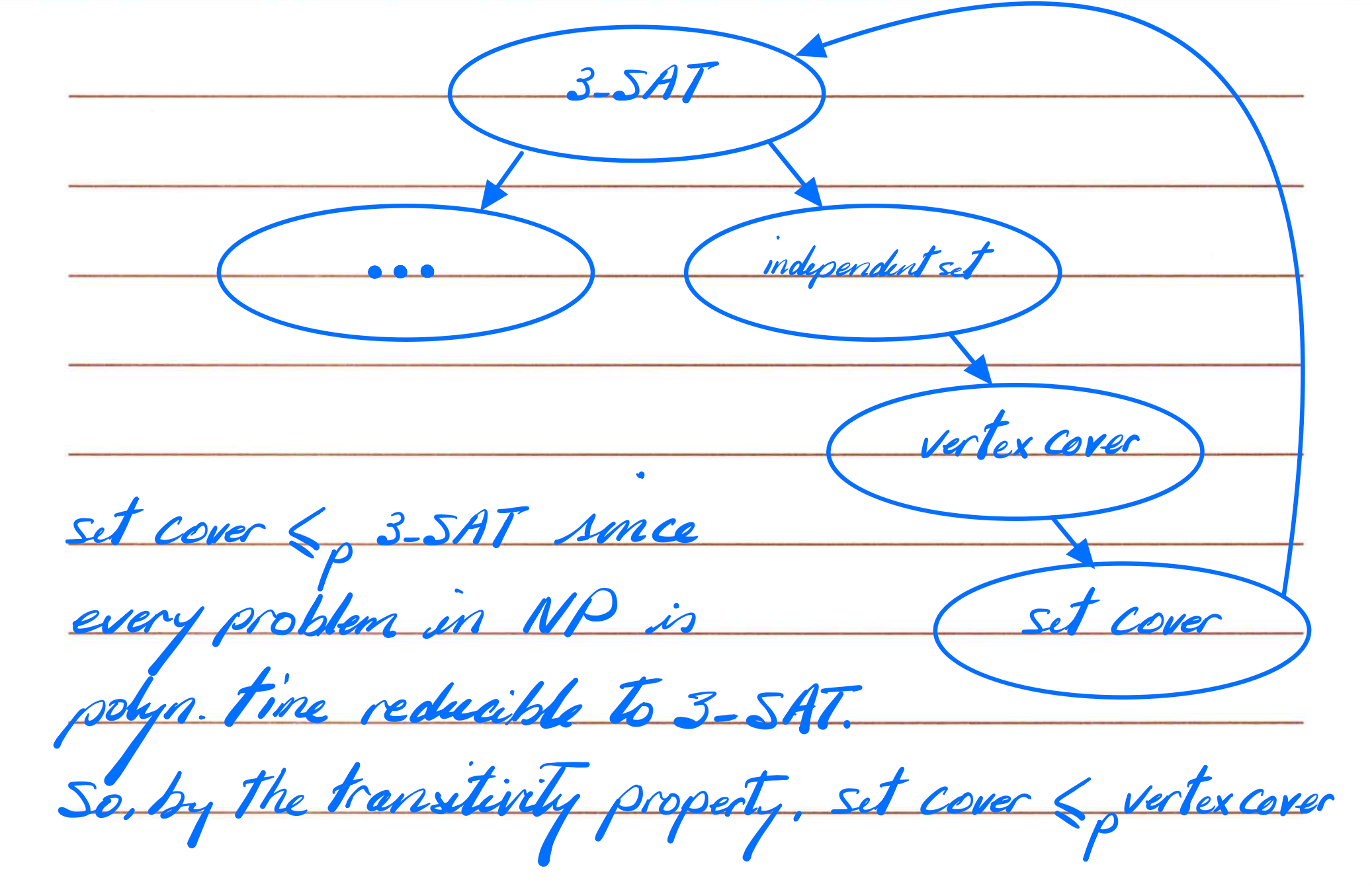
Transitivity of Reduction
Very crucial:
If Z ≤ ₚ Y and Y ≤ ₚ X, then Z ≤ ₚ X.
Therefore:
It is not necessary to start the reduction from "all NP problems"
It is only necessary to reduce from a problem that is already NP-complete
**SAT is the first problem to be proven NP-complete (Cook-Levin theorem),
therefore SAT becomes the "starting point" for all NP-complete proofs.**
How to prove that a problem X is NP-complete?
The classic three-step method:
Step 1: Prove X ∈ NP
Give a certificate and certifier.
Step 2: Choose a known NP-complete problem Y
For example:
3-SAT
Independent Set
Vertex Cover
Hamiltonian Cycle
Step 3: Prove Y ≤ ₚ X
That is:
Encode instance Y into instance X
and prove the correctness in both directions (YES→YES, NO→NO)
After completing the above three steps → X is NP-complete.
Collection of Proof Examples
This section compiles a series of proof problems, including commonly used construction methods.